
Dear Friend,
Yes, you read it right – nice.
When I see the word “nice,” I flinch!
Why? My seventh-grade English teacher noticed that “nice” was used so frequently in our assignments that she gave my class a homework assignment. A real doozy!
Make a list of 50—yes, fifty! synonyms for nice.
That assignment stuck with me. (It also took some work to find fifty synonyms. No internet then, so no easy fixes.)
If I mention something is “nice,” that’s damning it with faint praise. There are so many words that are more descriptive for a person, place, or thing (nouns).
If I use the word “nice” in my writing at all, it’s emulating what other people say, but don’t mean – that the item being called nice is “okay.” Nothing special, but positive, at least.
Every word makes a difference. So often we say things as a verbal “rubber stamp.” We’re expected to say things to approve of something or someone. “Nice” might be the one-word response. Is it sarcastic? A brush off?
What would you say to someone praising something they did that was “nice” – good or better? I’m excited to learn what you’d say! (And if you say – “nice,” I’ll know you’re teasing me or being snarky!) Answer in the comments box below.
Apply this to what an author says about their characters. For instance, my main female character, Louisa. In The Greatest Thing, she is: sweet, an empath, a “seer,” brilliant, responsive, a matchmaker, ecstatic, kind, a lover, and much more. I never describe her as “nice” or had the character use the word. The book uses “nice” when discussing clothing, e.g.“nice” clothes or being nice to someone.

A term I hadn’t heard until recently is “speculative fiction.” My guest author, Roger Gillespie, whose book, Saving Liberty, is debuting next week, will tell you about that. . .
Speculative fiction. The “what-if?” of the Sci-Fi genre. Lincoln survived Ford’s Theatre because John Wilkes Booth … was never born! H.G. Wells really had a working time machine in his basement lab. How else could he write about it in 1895? The British won the American Revolution!
Time travel fiction. The “what-if” we could fix the “what if?” that was created by the speculative fiction above … and change things?
Once you’ve twisted yourself into a pretzel trying to rationalize speculative and time-travel fiction, just imagine if Benjamin Franklin suddenly found himself in the 21st century. An 18th-century scientist and inventor who could never have envisioned the advances he was about to encounter.
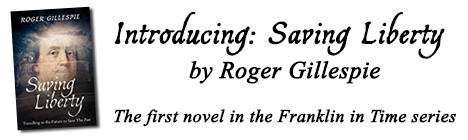
Franklin is on a secret mission to Williamsburg, Virginia to save the Founding Fathers from a British plot to neutralize them…no American Revolution… but he finds himself mysteriously transported to the 21st century. The cell phones, the clothes … the bus! None of these are as devastating to Franklin as when he finds out that—
The British Won the American Revolution!
Was this his timeline, or a strange parallel universe?
He would never find out if he couldn’t return to his time.
Saving Liberty launches April 14th on Amazon in both paperback and ebook formats.
Travelling to the Future to Save the Past
Return now to the 21st century, and think how great we have things. . . indoor plumbing, paved streets (well, mostly paved streets), air-conditioning, microwaves, running water, and computers.
If you’ve had your taste whetted for a real glimpse of Louisa, Click here to get your hands on Louisa’s Passion.
Until next week –
Happy Reading!
